
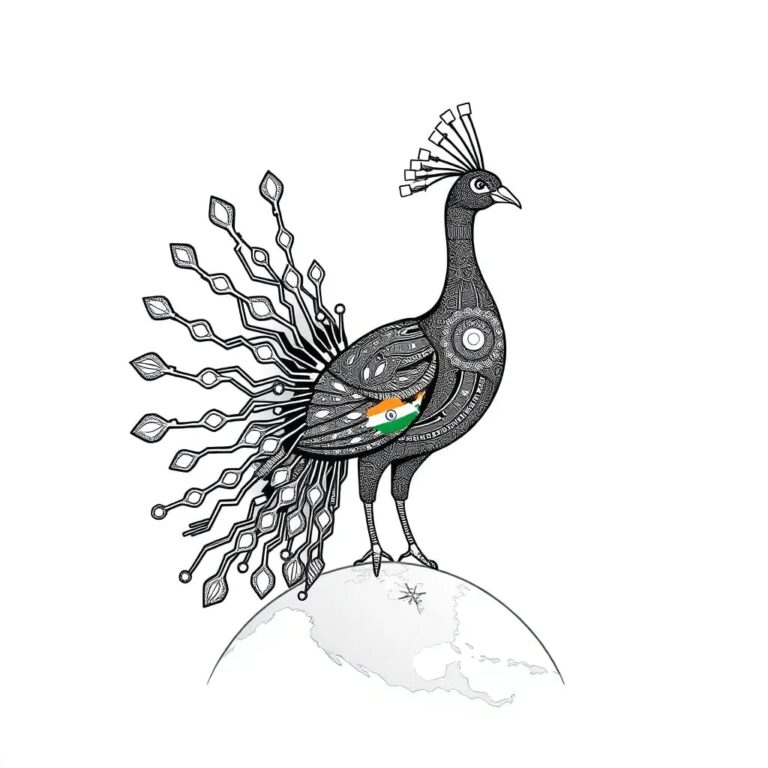
India AI Impact Summit Draws Global Tech Titans as New Delhi Stakes Claim in AI Governance
NEW DELHI — The upcoming India AI Impact Summit marks a significant milestone in the global AI supply chain, with prominent figures such as Jensen Huang, Founder and CEO of Nvidia, among the attendees. This summit is not merely a ceremonial occasion; it highlights India’s emergence as a key player in the world of artificial intelligence.
Joining Huang are other tech leaders, including Dario Amodei from Anthropic, Brad Smith from Microsoft, Julie Sweet of Accenture, Cristiano Amon from Qualcomm, Börje Ekholm of Ericsson, and Kiran Mazumdar-Shaw from Biocon Group. This assembly of executives is rarely seen outside of high-profile global forums such as Davos, underscoring the geopolitical significance of the summit.
India’s AI Ambition Meets Global Capital and Governance
The timing of this summit is crucial, as India’s AI economy is projected to reach $17 billion by 2027. Initiatives like the IndiaAI Mission are actively expanding computational infrastructure, nurturing indigenous AI models, and embedding AI into public systems.
The summit serves as a platform to address who will define the guardrails for the next generation of artificial intelligence. Main-stage sessions, supported by the Stanford Institute for Human-Centered AI (HAI), will delve into themes of trust and accountability in the AI landscape. Collaborations with prestigious institutions such as the Harvard Kennedy School and Gates Foundation will explore AI in diplomacy, information integrity, and youth empowerment.
FCRF’s Security Lens: AI for Secure India
As AI governance discussions unfold, cybersecurity remains a pressing concern. The Future Crime Research Foundation (FCRF) is taking a proactive role as a Knowledge Partner, hosting a session titled “AI for Secure India: Combating AI-Enabled Cybercrime, Deepfakes, Darkweb Threats and Data Breaches” on February 17, 2026.
This session will be moderated by Prof. Triveni Singh, featuring a panel of experts including Rakesh Maheshwari (Cyber Law & Data Governance Expert), Senior Advocate Vivek Sood (Supreme Court of India), Tarun Wig (Co-Founder & CEO, Innefu Labs), and Dr. Sapna Bansal (Shri Ram College of Commerce, University of Delhi). The primary focus will be on the dual role of AI as an economic accelerator and a multiplier of cyber risk.
As cyber threats evolve, from AI-generated deepfakes to automated phishing, FCRF emphasizes that security must be embedded in AI systems from conception, rather than retrofitted post-disruption.
Between Innovation and Integrity
As discussions on computational safety and scalability take center stage at the summit, a broader narrative emerges — one of trust-centric innovation. The convergence of Nvidia’s hardware prowess, Anthropic’s focus on AI safety, Microsoft’s governance perspective, and India’s domestic policy framework suggests that the future of AI will not be dictated solely by Silicon Valley.
In New Delhi, amid tightly curated panels and packed halls, the real negotiation is less about technological supremacy and more about constructing an AI-powered economy that is innovative, sovereign, and secure. In this context, the importance of cybersecurity is underscored; it is no longer a peripheral issue but a foundational element of AI development.







