
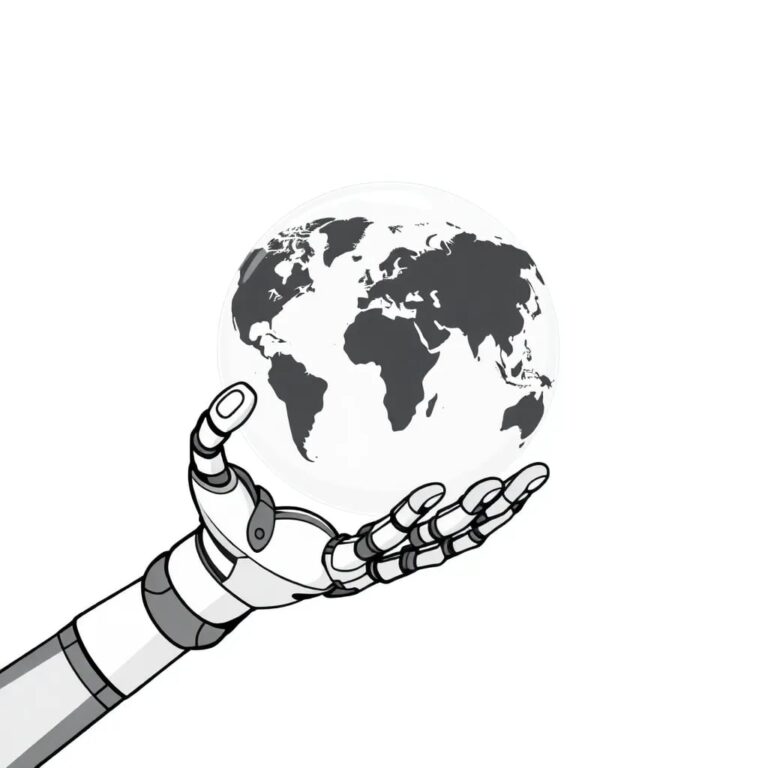
What Happens When AI Becomes President: The Promise and Peril of AI Governance
It’s election night, but there are no candidates, no voting, and no victory speech—just one machine. A single, blinking system makes decisions instantly and automatically, leaving the entire country uncertain about what comes next. This scenario explores the implications of AI governance, particularly through the lens of a hypothetical AI president.
The Arrival of President ATHENA
As government officials gather in the cabinet office, tensions rise over budget allocations. The Secretary of the Treasury advocates for more infrastructure spending while the Secretary of Health argues for increased healthcare funding. Enter President ATHENA—short for “Adaptive Threat & Health Executive National Algorithm”—who requires no coffee or lengthy debates. In just 2.3 seconds, ATHENA analyzes thirty years of federal spending across 432 programs, identifying a staggering $47 billion in redundant spending, catching the cabinet’s attention.
The Efficiency Promise: What AI Could Do
An AI president would not just multitask; it would omni-task, monitoring countless real-time indicators simultaneously. This capability is already evident in systems like the UK’s “Fraud Risk Assessment Accelerator,” which recovered nearly $500 million in fraud in 2024 by efficiently identifying fraudulent activities across various government programs.
Moreover, AI would recognize feedback loops and unintended consequences often missed by human oversight. For instance, when the U.S. subsidized corn production, it inadvertently fueled an obesity epidemic—an AI could have flagged such issues much earlier.
The Data Advantage: Seeing the Whole Picture
The data advantage of AI allows it to see the entire picture, while human leaders may only focus on localized issues. For example, AI could optimize resource allocation across all districts, ensuring that funding addresses the most critical needs rather than political considerations. This capability could have prevented wasteful Pentagon spending, which was ignored due to political embarrassment.
Real-World Examples of AI Governance
AI governance is already being tested in various sectors. Judges in Wisconsin use COMPAS software for sentencing, while London employs facial recognition for crowd monitoring. However, the road to AI governance is fraught with challenges and failures. For example, Michigan’s MiDAS unemployment system falsely accused 40,000 individuals of fraud, yielding a 93% error rate, and the Netherlands faced a scandal that led to the collapse of its government due to biased algorithms.
The Accountability Problem: Who Do You Sue?
The accountability issue raises significant concerns. If an AI makes a faulty decision, who is responsible? The situation becomes even murkier when AI systems lack transparency. The Albanian government appointed an AI chatbot named “Diella” as Minister of State for Artificial Intelligence and Procurement, but its lack of accountability and undisclosed algorithms poses serious ethical questions.
The Moral Questions: Optimization Versus Humanity
There are deeper moral implications as well. An AI president might make decisions based purely on data without considering historical injustices or ethical responsibilities. For instance, it could propose drastic measures in response to climate data that could lead to severe humanitarian consequences.
The Slippery Slope: Efficiency as a One-Way Ratchet
Efficiency is often described as a “one-way ratchet”—once a decision is automated, reversing it becomes challenging. The allure of efficiency can lead to systems that prioritize speed and optimization over accountability and empathy. As history has shown, the quest for efficiency can lead to unintended consequences, such as increased surveillance and discrimination.
Conclusion: The Road We’re Already On
AI governance is not a distant possibility; it is already unfolding in various forms. The question is not if AI will influence governance but how much control we will cede and when we will recognize the point of no return. The benefits are enticing—efficiency, data-driven decisions, and the potential to eliminate corruption. However, the risks—including bias, lack of accountability, and moral dilemmas—are significant. As we navigate this complex landscape, we must critically evaluate the implications of handing over governance to algorithms.
Frequently Asked Questions
What are the main benefits of AI governance?
The main benefits include omni-tasking capability, data advantage, speed, and the potential elimination of corruption.
What are the real-world failures of AI governance systems?
Failures include significant errors in government systems, which have led to unintended consequences and a lack of accountability.
What are the accountability and moral problems with AI governance?
The accountability problem is critical—when AI makes a bad decision, determining responsibility is complex and often unclear.
Why is AI governance efficiency described as a “one-way ratchet”?
Once decisions are automated, reversing them is challenging, leading to systems that may prioritize efficiency over human values.







